

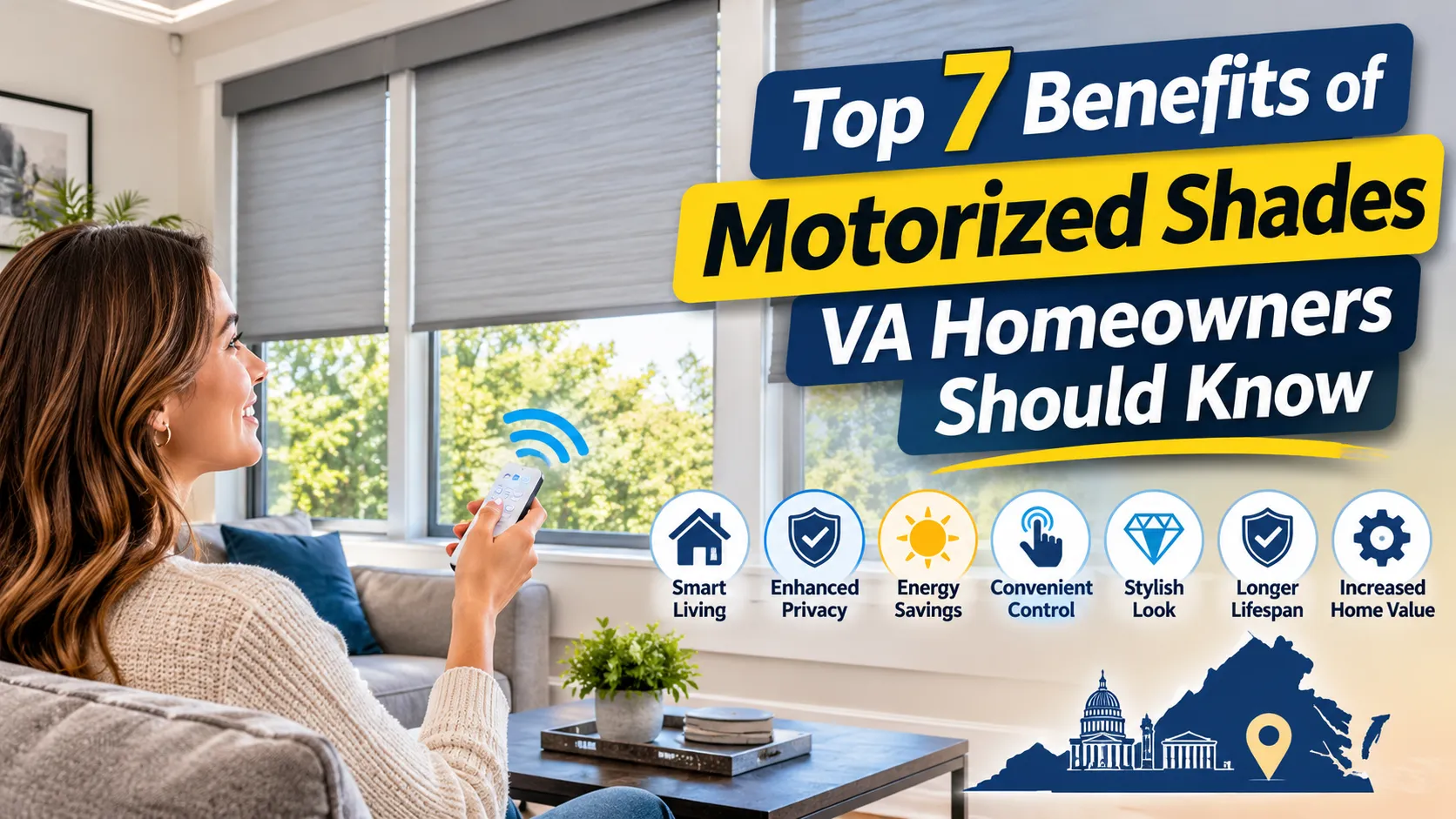
A homeowner in Great Falls spends $40,000 on floor-to-ceiling windows for a new great room. Six months later, those same windows are the reason nobody uses the room after 2 PM. The glare is unbearable, the cordless pull chain is twelve feet out of reach, and the dog has already chewed through one lift cord. This is the actual problem motorized shades VA homeowners run into once the windows get bigger than the hardware was designed for.
Manual shades work fine on a standard double-hung window. They stop working once ceilings hit nine feet, windows stretch past 60 inches wide, or a household includes kids and pets who treat cords like toys. That’s the gap motorized window treatments were built to close, and it’s worth walking through the specific benefits rather than the marketing version of “convenience.”
1. You Stop Fighting Physical Access
Tall windows and skylights are the most common reason Virginia homeowners call BAMU Blinds in the first place. A 10-foot window doesn’t have a pole long enough to make manual operation comfortable, and most homeowners won’t climb a ladder twice a day to adjust light. Motorized shades remove the access problem entirely. One tap on a remote or phone app raises or lowers a shade regardless of height, window placement, or whether it sits above a bathtub, stairwell, or kitchen sink.
2. Cordless Design Actually Protects Kids and Pets
This isn’t a soft-sell safety point — it’s a documented hazard. Corded blinds remain one of the most cited strangulation risks for children under five, and the CPSC has pushed the window covering industry toward cordless defaults for exactly that reason. BAMU’s motorized roller, Roman and cellular shades are built cordless from the start, whether they run on battery power or a hardwired system. There’s no loop, no chain, no dangling pull — just a motor housed inside the headrail. For households with toddlers or curious cats, that single design change removes a risk that manual shades never fully solve, even with cord cleats and tension devices.
3. Scheduling Beats Remembering
Most people don’t forget to lower shades because they’re lazy. They forget because it’s not habitual — nobody wakes up thinking “the west-facing office will hit 95 degrees by 2 PM unless I act now.” Automated scheduling handles that blind spot. Set shades to close before peak afternoon sun and reopen at dusk, and the house manages its own light exposure. Over a Virginia summer, that consistency does more for interior temperature control than any single manual adjustment ever could.
4. Energy Savings That Show Up on the Bill, Not Just in Theory
Windows are a major point of heat gain and heat loss, full stop. The Department of Energy attributes a significant share of residential heating and cooling load to windows specifically. Motorized shades timed to close during peak sun exposure reduce solar heat gain in summer and, when closed at night, cut conductive heat loss in winter. This isn’t a marginal effect. Homeowners who automate their shade schedules around actual sun exposure — not a fixed morning/evening routine — typically see the clearest reduction in HVAC cycling. The mechanism is simple: less direct solar load means the AC compressor runs less.
5. Smart Home Integration Without the Gimmick Factor
A lot of “smart” home products are smart in name only — an app that controls one thing and nothing else. Motorized shades are different because they integrate into systems people already use for other purposes. BAMU’s shades connect through smartphone control, standard remotes, and voice assistants, which means they fold into an existing Alexa or Google Home routine instead of requiring a separate ecosystem. A homeowner can group “Good Morning” to open shades, start coffee, and adjust the thermostat in one voice command. That’s not a novelty feature. It’s the same logic that made smart thermostats standard rather than optional.
-
Smartphone app control, individual or grouped by room
-
Standard remote for single or multi-shade operation
-
Voice control through major assistant platforms
-
Scene and schedule automation tied to time of day or sun position
6. Window Treatments That Don’t Compete With the Architecture
Cord-operated shades with visible hardware, looped chains, and bulky valances fight against clean, modern window design. This matters more in Northern Virginia than it used to. Newer construction and renovated homes increasingly favor large glass expanses, minimal trim, and uninterrupted sightlines. Motorized shades with hidden headrails and no exposed cord hardware preserve that intended look. Cellular shades in particular hold their shape and stack tightly when raised, which keeps the window visually unobstructed. Roman shades, by contrast, add texture and softness for homeowners who want a window treatment that still reads as a design element rather than disappearing hardware.
7. Privacy Control That Doesn’t Require a Trip to the Window
Privacy and light control aren’t the same problem, even though manual shades treat them that way. A single shade position is a compromise between “can’t see out” and “neighbors can see in.” Automated shades let homeowners set different positions throughout the day — nearly closed at night for privacy, partially raised during the day for light without direct exposure. For homes near busy streets, corner lots, or properties with ground-floor bedrooms, that flexibility solves a real problem instead of forcing a single all-or-nothing setting.
Battery-Operated or Hardwired: The Trade-off Nobody Explains Clearly
This decision gets glossed over in most sales conversations, and it shouldn’t. Battery-operated systems install faster, work in rooms without nearby outlets, and suit renovations where running new wiring isn’t practical. The trade-off is maintenance — batteries need periodic recharging or replacement, more often in shades that cycle multiple times a day. Hardwired systems eliminate that maintenance cycle entirely but require electrical work during installation, which usually means planning around a renovation timeline rather than retrofitting after the fact. Neither option is universally better. The right call depends on whether the project is new construction, a full remodel, or a straightforward window upgrade in an existing room.
What Installation Actually Looks Like
BAMU Blinds runs this as a defined process rather than an open-ended timeline. It starts with a free consultation, where measurements are taken on-site rather than estimated from a floor plan — precision matters here because a shade that’s even a half-inch off on a motorized headrail will show it. Most residential projects move from consultation to finished installation in about five days, which is fast relative to custom window treatment timelines generally. Products carry a lifetime warranty on most lines, which matters specifically for motorized components since motor failure is the most common point of breakdown in any electric shade system over a long ownership period.
The Real Decision Point
The question isn’t whether electric shades for windows are better than manual ones in the abstract. They’re better for specific problems: hard-to-reach windows, households with young kids or pets, rooms with heavy solar exposure, and homeowners already running a smart home system. If none of those apply, manual shades remain cheaper and simpler. For Virginia homes with any of those conditions, though, motorized window shades Northern Virginia homeowners install tend to solve problems that manual hardware was never going to fix, no matter how good the fabric or the mounting job was.
FAQs
-
Do motorized shades work during a power outage?
Battery-operated systems keep working as normal since they don’t depend on home power. Hardwired systems lose motor function during an outage, though most retain manual override options depending on the model.
-
Can motorized shades be added to existing windows, or only new construction?
Both. Battery-operated systems are commonly retrofitted into existing windows without any wiring changes, which is why they’re popular for renovations and room-by-room upgrades.
-
How long do the motors typically last?
Quality motors are built for years of daily cycling, which is part of why lifetime warranty coverage on components matters — it protects against the one part most likely to need replacement over time.
-
Is voice control reliable, or does it require constant troubleshooting?
Voice control through established platforms like Alexa or Google Home is generally stable because it relies on infrastructure those companies already maintain, rather than a proprietary app built only for the shades themselves.